Home Visit
 Upload






Preventive Healthcare
Circle Of Willis: Anatomy, Function, And Importance
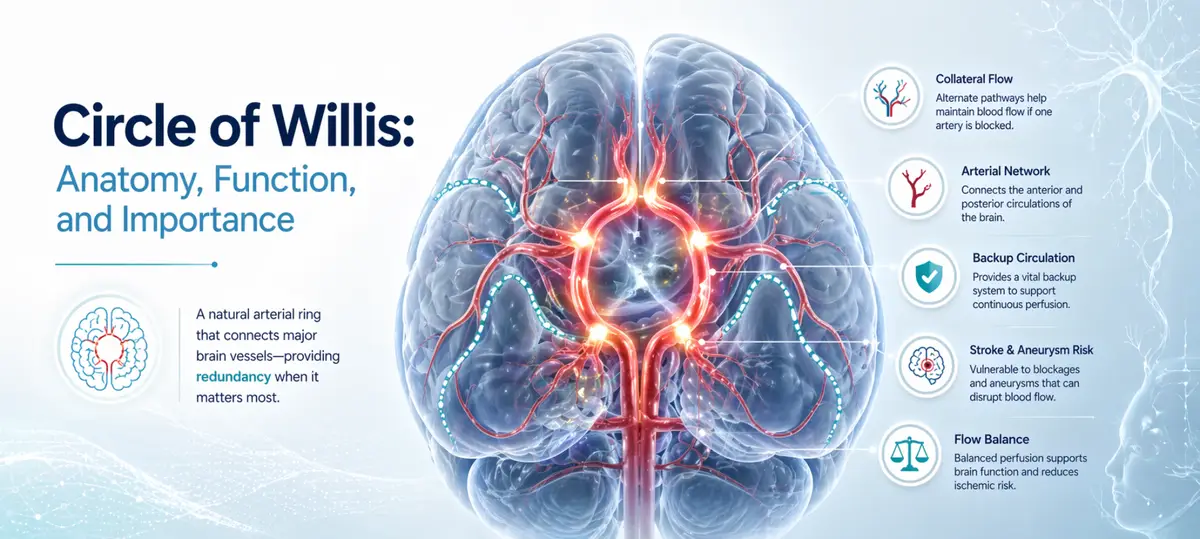
Table of Contents
- What Is The Circle Of Willis?
- Location Of The Circle Of Willis In The Brain
- Anatomy Of The Circle Of Willis
- Arteries That Form The Circle Of Willis
- Function Of The Circle Of Willis
- Why The Circle Of Willis Is Important For Brain Health
- Common Variations In The Circle Of Willis
- Conditions Associated With The Circle Of Willis
- Symptoms Of Circle Of Willis Related Disorders
- How Disorders Of The Circle Of Willis Are Diagnosed
- Treatment Options For Circle Of Willis Conditions
- Key Takeaways
- FAQs About The Circle Of Willis
- Conclusion
Your brain needs a constant blood supply to work well. One of the key safety systems in this process is the Circle of Willis. This is a ring-like network of arteries at the base of your brain that helps connect major blood vessels and support blood flow if one pathway becomes narrowed or blocked.
Understanding the Circle of Willis can help you better understand how the brain vascular system protects itself. It also explains why this area matters in conditions such as stroke, aneurysm, and other blood vessel disorders.
What Is The Circle Of Willis?
The Circle of Willis is a circular arterial connection found at the base of your brain. It links the front and back blood supply of the brain and acts as a collateral pathway. In simple terms, it can help redirect blood if one of the main vessels has reduced flow.
You can think of it as a built-in backup route. If one side of the circulation is compromised, the Circle of Willis may help maintain blood flow to important brain tissue. This protective role depends on how complete and well formed the circle is in your body.
Location Of The Circle Of Willis In The Brain
The Circle of Willis is located at the base of the brain in the subarachnoid space. It lies near the pituitary stalk, optic chiasm, and hypothalamus.
This location is important because many critical nerves and blood vessels pass through the same region. Any swelling, bleeding, aneurysm, or narrowing here can affect nearby structures and cause serious neurological symptoms.
Anatomy Of The Circle Of Willis
The Circle of Willis is not a single artery. It is a connection between several arteries that form a ring or polygon. These vessels join the anterior circulation, which mainly comes from the internal carotid artery, with the posterior circulation, which is supplied through the vertebrobasilar system.
A classic complete circle includes:
- Two anterior cerebral arteries
- One anterior communicating artery
- Two terminal parts of the internal carotid artery
- Two posterior communicating arteries
- Two posterior cerebral arteries
The middle cerebral arteries are close to this region but are not part of the classic ring itself.
Arteries That Form The Circle Of Willis
Here is a simple look at the arteries involved:
- Anterior cerebral arteries: These supply parts of the frontal and parietal lobes.
- Anterior communicating artery: This joins the right and left anterior cerebral arteries.
- Internal carotid artery: Each internal carotid artery brings oxygen-rich blood to the front part of the brain.
- Posterior communicating arteries: These connect the anterior and posterior circulations.
- Posterior cerebral artery: Each posterior cerebral artery supplies areas such as the occipital lobe and parts of the temporal lobe.
Together, these vessels form an important junction within the brain vascular system.
Function Of The Circle Of Willis
The main function of the Circle of Willis is collateral circulation. That means it can provide an alternative route for blood flow if one artery becomes narrowed, blocked, or damaged.
This matters because brain tissue is highly sensitive to reduced oxygen supply. A complete and well-functioning circle may help reduce the severity of ischaemia in some cases. It may also help balance pressure and flow between the left and right sides of the brain, and between the front and back circulations.
However, it is important to understand that the Circle of Willis is not a guarantee against stroke. Its protective effect varies from person to person.
Why The Circle Of Willis Is Important For Brain Health
The Circle of Willis matters because it supports blood flow to one of the most vital organs in your body. When blood vessels in the brain are affected by a clot, narrowing, or rupture, the presence of a strong collateral pathway may influence how much damage occurs.
This is why doctors pay attention to this area when evaluating stroke, transient ischaemic attack, aneurysm, and some rare vascular disorders. It is also one of the reasons brain scans may comment on arterial anatomy even when the scan was done for another complaint.
Common Variations In The Circle Of Willis
Not everyone has a textbook version of the Circle of Willis. In fact, anatomical variation is very common.
In many people, one or more segments may be smaller than usual, absent, duplicated, or incomplete. The anterior communicating artery and posterior communicating arteries are common sites for variation.
A person can still be healthy with an incomplete circle. But if a major vessel becomes blocked, the backup flow may be less effective than in someone with a more complete ring. This is one reason outcomes can differ between people with similar vascular events.
Conditions Associated With The Circle Of Willis
Several clinical conditions are linked to this region:
- Brain aneurysm: The Circle of Willis is a common site for intracranial aneurysms, especially near arterial junctions.
- Ischaemic stroke: Reduced blood flow due to blockage can affect arteries linked to the circle.
- Haemorrhagic stroke: Bleeding from a ruptured aneurysm or vessel can occur in this area.
- Transient ischaemic attack: Temporary interruption of blood flow may involve vessels connected to the circle.
- Carotid artery disease: Narrowing of vessels can affect blood reaching the circle.
- Moyamoya disease: This rare condition causes progressive narrowing of key arteries around the base of the brain.
- Subclavian steal syndrome: Altered blood flow in the vertebral system can affect posterior brain circulation.
Symptoms Of Circle Of Willis Related Disorders
The Circle of Willis itself does not usually cause symptoms. Symptoms happen when there is an associated disorder such as aneurysm, stroke, or reduced blood flow.
Possible symptoms include:
- Sudden weakness or numbness, especially on one side
- Difficulty speaking or understanding speech
- Sudden vision loss or double vision
- Dizziness or loss of balance
- Severe sudden headache
- Facial drooping
- Confusion
- Trouble walking
- Loss of consciousness in severe cases
Knowing the stroke symptoms and acting quickly can make a major difference to treatment and recovery. A sudden severe headache, especially one that feels unusual or explosive, also needs urgent medical attention.
How Disorders Of The Circle Of Willis Are Diagnosed
Doctors usually diagnose Circle of Willis related problems with brain imaging. Depending on your symptoms, this may include CT, MRI, CT angiography, MR angiography, or catheter angiography. These tests help show blood vessels, aneurysms, narrowing, bleeding, or blocked flow.
Your doctor will choose the right test based on how urgent the situation is and what they need to confirm.
Treatment Options For Circle Of Willis Conditions
Treatment depends on the underlying problem, not on the arterial circle alone.
If There Is A Stroke
If a stroke is caused by a blocked artery, treatment may include clot-busting medicine or procedures to remove the clot, depending on timing and eligibility. If the stroke is due to bleeding, treatment focuses on stabilising the patient and controlling the source of bleeding.
If There Is A Brain Aneurysm
An unruptured aneurysm may be monitored or treated based on its size, shape, location, symptoms, and rupture risk. Treatment can include endovascular coiling or surgical clipping.
If There Is Vessel Narrowing Or Vascular Disease
Doctors may recommend blood pressure control, cholesterol management, diabetes care, antiplatelet treatment, and lifestyle changes. In some cases, surgery or vascular intervention may be needed.
If There Is A Rare Vascular Condition
Conditions such as moyamoya disease may need specialist neurology or neurosurgical care. Treatment plans are individual and often involve close imaging follow-up.
Key Takeaways
- The Circle of Willis is an arterial ring at the base of your brain.
- It connects the front and back blood supply of the brain.
- Its main role is to provide collateral blood flow.
- Not everyone has a complete Circle of Willis.
- Variations are common and may affect how well backup blood flow works.
- This area is clinically important in stroke, aneurysm, and other vascular disorders.
- Imaging tests help doctors assess its structure and related conditions.
FAQs About The Circle Of Willis
What Percentage Of People Have A Complete Circle Of Willis?
The exact percentage varies across studies and imaging methods, but a fully complete classic Circle of Willis is thought to be present in less than half of people. Variations and incomplete patterns are common.
Does The Basilar Artery Feed The Circle Of Willis?
Yes. The basilar artery contributes to the posterior circulation and gives rise to vessels that connect with the Circle of Willis through the posterior cerebral artery region.
Where Is The Circle Of Willis Located?
It is located at the base of the brain in the subarachnoid space, near the pituitary stalk, optic chiasm, and hypothalamus.
What Arteries Form The Circle Of Willis?
It is formed by the anterior cerebral arteries, anterior communicating artery, terminal internal carotid segments, posterior communicating arteries, and posterior cerebral arteries.
What Is The Function Of The Circle Of Willis?
Its main function is to provide collateral circulation. This helps maintain blood flow if one main artery is narrowed or blocked.
Why Is The Circle Of Willis Important?
It is important because it can help protect brain tissue during certain blood flow problems. It is also a common site for aneurysms and other vascular conditions.
Can The Circle Of Willis Prevent Strokes?
Not fully. A complete and well-functioning circle may reduce the severity of reduced blood flow in some situations, but it does not prevent all strokes.
What Are Common Variations Of The Circle Of Willis?
Common variations include missing segments, narrowed segments, duplication, fenestration, and incomplete connections, especially in the communicating arteries.
What Disorders Are Associated With The Circle Of Willis?
Commonly associated disorders include brain aneurysm, ischaemic stroke, haemorrhagic stroke, transient ischaemic attack, carotid disease, moyamoya disease, and other cerebrovascular disorders.
How Are Circle Of Willis Abnormalities Diagnosed?
They are usually diagnosed through imaging such as CT angiography, MR angiography, MRI, CT, or catheter angiography.
Conclusion
The Circle of Willis is a small but vital part of your brain’s blood supply system. It helps connect major arteries and may offer a protective backup route when blood flow is disrupted. While it cannot completely prevent stroke or other serious conditions, it plays an important role in how the brain responds to vascular stress.
You may not think about your brain blood vessels every day, but managing your overall vascular health matters. Monitoring blood pressure, cholesterol, blood sugar, and other risk factors through a preventive health checkup can support better long-term wellbeing. Metropolis Healthcare supports proactive care with 4,000+ tests and profiles, speciality testing, full body checkups, reliable reports, quick turnaround time, and home sample collection across a strong network of 10,000 touchpoints. With easy booking through the website, app, call, and WhatsApp, Metropolis Healthcare makes it simpler to stay informed about your health.