Home Visit
 Upload






Preventive Healthcare
Menstrual Hygiene Day 2026: When To Take Hormone Tests, PCOS Screening And Iron Check
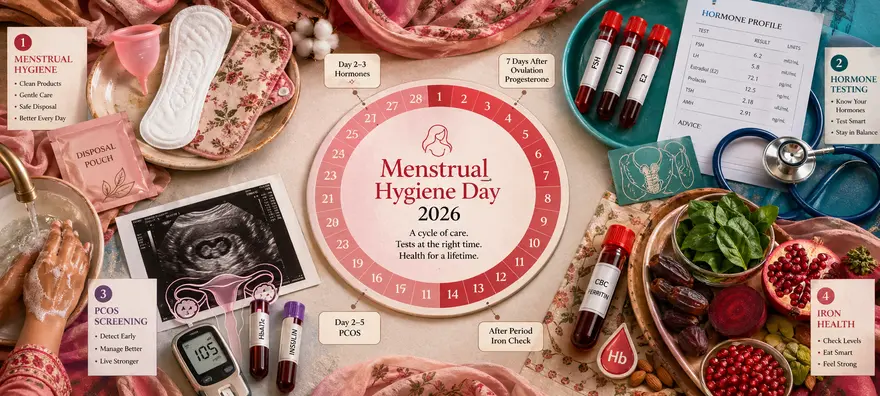
Table of Contents
- What Is Menstrual Hygiene Day?
- When Is Menstrual Hygiene Day 2026 Celebrated?
- Theme Of Menstrual Hygiene Day 2026
- Why Menstrual Hygiene Awareness Is Important
- Common Challenges Around Menstrual Hygiene
- Healthy Menstrual Hygiene Practices
- Which Tests Are Relevant For Menstrual Health?
- When To Take Hormone Tests During Your Cycle
- When To Take PCOS Screening Tests
- When To Take An Iron Check
- Test Timing Guide For Menstrual Health
- Tips Before Hormone And Menstrual Health Tests
- When To Seek Medical Advice For Menstrual Issues
- How You Can Participate In Menstrual Hygiene Day
- Role Of Preventive Healthcare In Women’s Health
- Key Takeaways
- FAQs About Menstrual Hygiene Day 2026
Menstrual Hygiene Day 2026 will be observed on Thursday, May 28. It is a global reminder that periods are a normal part of health and should never be surrounded by shame, silence, or neglect.
Menstrual health is not only about using the right period product. It is also about understanding your cycle, noticing changes, following safe hygiene habits, and knowing when to get tested.
Your menstrual cycle can give important clues about your hormones, iron levels, thyroid health, PCOS risk, and overall wellbeing. Some tests give more accurate results when they are done on specific cycle days. This is why timing matters.
What Is Menstrual Hygiene Day?
Menstrual Hygiene Day is a global awareness day observed every year on May 28. It focuses on menstrual health, dignity, education, access to safe period products, and the need to end stigma around periods.
The date has symbolic meaning. May is the fifth month of the year, which represents the average duration of menstruation. The 28th day represents the average length of a menstrual cycle.
Menstrual Hygiene Day encourages open conversations so that girls, women, and people who menstruate can manage their periods safely and confidently.
When Is Menstrual Hygiene Day 2026 Celebrated?
Menstrual Hygiene Day 2026 will be celebrated on Thursday, May 28.
The day is observed on the same date every year. Schools, communities, healthcare organisations, NGOs, workplaces, and individuals use this day to spread awareness about menstrual hygiene, period dignity, and menstrual health.
Theme Of Menstrual Hygiene Day 2026
The official Menstrual Hygiene Day movement now focuses on the long-term mission: Together for a #PeriodFriendlyWorld.
This means creating a world where:
- Menstruation is accepted as a normal part of life
- Period stigma and taboos are removed
- Everyone has access to menstrual education
- Safe and affordable period products are available
- Toilets, water, and disposal facilities support menstrual hygiene
- Menstrual health services are accessible to everyone
So, if you are looking for the menstrual hygiene day 2026 theme, the key message is to work towards a period-friendly world where menstruation does not limit health, education, work, or dignity.
Why Menstrual Hygiene Awareness Is Important
Menstrual hygiene awareness matters because it helps you:
- Understand your body without shame or fear
- Use period products safely
- Reduce the risk of rashes, irritation, and infections
- Identify abnormal bleeding patterns early
- Speak openly about pain, heavy bleeding, or irregular periods
- Support young girls during their first periods
- Encourage timely medical advice for menstrual concerns
- Improve school, workplace, and community support for menstruation
Good menstrual hygiene practices also help reduce misinformation. When periods are discussed openly, it becomes easier to seek help when something feels unusual.
Common Challenges Around Menstrual Hygiene
Many girls and women still face barriers that affect menstrual health and dignity, such as:
- Lack of correct information about periods
- Shame or embarrassment while discussing menstruation
- Limited access to safe period products
- Poor toilet and disposal facilities
- Fear of staining clothes
- Missing school, work, or social activities during periods
- Ignoring severe pain or heavy bleeding
- Using one pad, tampon, or cloth for too long
- Not knowing when a menstrual problem needs medical attention
These challenges can affect physical health, confidence, education, work, and emotional wellbeing.
Healthy Menstrual Hygiene Practices
Healthy period care does not need to be complicated. These period care tips can help you manage your cycle safely:
- Change sanitary pads every 4 to 6 hours, or earlier if soaked
- Change tampons as directed and avoid wearing them for too long
- Clean menstrual cups properly before and after use
- Wash your hands before and after changing period products
- Use clean, breathable underwear
- Avoid scented products in the intimate area
- Dispose of used products safely and hygienically
- Wash reusable cloth pads properly and dry them fully in sunlight when possible
- Track your cycle dates, flow, pain, and symptoms
- Seek medical advice if bleeding, pain, discharge, or odour feels unusual
Menstrual hygiene practices should support comfort, safety, and dignity. Choose products that suit your body, lifestyle, access, and comfort.
Which Tests Are Relevant For Menstrual Health?
Menstrual symptoms can sometimes be linked to hormonal changes, PCOS, anaemia, thyroid imbalance, vitamin deficiency, or other health concerns. Your doctor may advise specific tests based on your symptoms.
Common tests relevant to menstrual health include:
- FSH test
- LH test
- Estradiol test
- Progesterone test
- Testosterone test
- AMH test
- Prolactin test
- Thyroid profile
- CBC
- Ferritin and iron studies
- Blood sugar and insulin tests
- HbA1c
- Vitamin D and vitamin B12 tests
- Pelvic ultrasound
When To Take Hormone Tests During Your Cycle
Cycle day 1 is the first day of proper menstrual bleeding, not light spotting. If your doctor asks for a day 2 or day 3 test, count from the first day of full bleeding.
FSH, LH And Estradiol
Best time: Day 2 to day 3 of the menstrual cycle
These tests are often done early in the cycle because hormone levels are closer to baseline at this time. They may be used to assess ovarian function, menstrual irregularity, fertility concerns, and hormone imbalance.
Your doctor may advise testing in the morning. Some tests may require fasting depending on the lab and the full panel advised.
Testosterone And Other Androgens
Best time: Often day 2 to day 5, as advised by your doctor
Testosterone and other androgen tests may be recommended if you have acne, excess facial hair, hair thinning, irregular periods, or suspected PCOS.
Your doctor may also advise DHEAS, androstenedione, SHBG, insulin, fasting glucose, and HbA1c depending on your symptoms.
AMH Test
Best time: Usually any day of the menstrual cycle
AMH is often used as one marker of ovarian reserve. Unlike some other reproductive hormones, it can usually be tested on any cycle day. Your doctor will interpret it with your age, symptoms, ultrasound findings, and other tests.
Progesterone Test
Best time: Around 7 days after ovulation
Progesterone rises after ovulation. For a 28-day cycle, this is often around day 21. But if your cycle is longer, the test should be timed later.
For example:
- If your cycle is 28 days, progesterone may be checked around day 21
- If your cycle is 32 days, it may be checked around day 25
- If your cycle is irregular, ovulation tracking may be needed
This test is often used to check whether ovulation has occurred.
Prolactin Test
Best time: Morning, as advised by your doctor
Prolactin may be checked if you have irregular periods, missed periods, milky nipple discharge, or fertility concerns. Stress, sleep, exercise, and some medicines can affect results, so follow your doctor’s instructions before testing.
Thyroid Profile
Best time: Morning is commonly preferred
Thyroid disorders can affect periods, weight, mood, energy, hair, skin, fertility, and pregnancy planning. A thyroid profile may include TSH, T3, and T4.
If you take thyroid medicine or supplements, ask your doctor how to time the test.
When To Take PCOS Screening Tests
PCOS, or polycystic ovary syndrome, can cause irregular periods, acne, excess hair growth, weight changes, insulin resistance, and difficulty with ovulation.
For PCOS screening, your doctor may advise:
- FSH
- LH
- Testosterone
- DHEAS
- SHBG
- Prolactin
- TSH
- Fasting glucose
- Fasting insulin
- HbA1c
- Lipid profile
- Pelvic ultrasound
Best time for hormone tests: Day 2 to day 5 of the menstrual cycle, unless your doctor advises otherwise.
Best time for pelvic ultrasound: Often day 2 to day 5, depending on your doctor’s advice and the reason for the scan.
If your periods are irregular or absent, do not delay care while waiting for the perfect cycle day. Your doctor may guide you on testing at any suitable time or after medically induced bleeding when needed.
When To Take An Iron Check
Heavy periods can lower iron stores over time. This can lead to iron deficiency or anaemia.
Tests that may help include:
- CBC
- Serum ferritin
- Serum iron
- TIBC
- Transferrin saturation
Best time: A few days after your period ends or as advised by your doctor.
If you are actively bleeding heavily, your doctor may still advise urgent testing. But for routine iron assessment, testing after your period may give a more stable picture.
You may need an iron check if you have:
- Heavy bleeding
- Long periods
- Fatigue
- Dizziness
- Headache
- Breathlessness
- Hair fall
- Pale skin
- Fast heartbeat
- Craving ice or non-food items
Do not start iron supplements without medical advice, as the dose and duration depend on your reports and the cause of deficiency.
Test Timing Guide For Menstrual Health
|
Test |
Common Timing |
Why Timing Matters |
|
FSH |
Day 2 to day 3 |
Gives baseline ovarian hormone information |
|
LH |
Day 2 to day 3 |
Helps assess hormone pattern and PCOS risk |
|
Estradiol |
Day 2 to day 3 |
Helps interpret ovarian function with FSH |
|
Testosterone |
Day 2 to day 5 |
Useful in PCOS and androgen excess evaluation |
|
AMH |
Any cycle day |
Usually stable across the cycle |
|
Progesterone |
7 days after ovulation |
Helps confirm ovulation |
|
Thyroid profile |
Morning preferred |
Helps assess thyroid-related menstrual changes |
|
CBC |
Any day, or after period for routine check |
Helps detect anaemia and infection |
|
Ferritin and iron studies |
After period for routine assessment |
Helps assess iron stores more clearly |
|
Pelvic ultrasound |
Often day 2 to day 5 |
Helps assess ovaries, uterus, and cycle-related findings |
Tips Before Hormone And Menstrual Health Tests
Before testing, keep these points in mind:
- Track your period dates for at least 2 to 3 cycles
- Note the first day of full bleeding
- Tell the lab or doctor your cycle day
- Share details of medicines, hormonal pills, supplements, and fertility treatment
- Avoid stopping prescribed medicines unless your doctor tells you to
- Ask whether fasting is needed
- Inform your doctor if you take biotin supplements
- Follow timing instructions for progesterone testing carefully
- Keep previous reports for comparison
Biotin, often found in hair, skin, and nail supplements, can affect some lab test results. Your doctor or lab can guide you on whether you should stop it before testing.
When To Seek Medical Advice For Menstrual Issues
You should speak to a doctor if you notice:
- Periods that suddenly become very heavy
- Bleeding between periods
- Bleeding after sex
- Periods lasting more than 7 days
- Severe cramps that affect daily life
- Missed periods without pregnancy
- Periods that are very irregular
- Foul-smelling discharge
- Fever with pelvic pain
- Dizziness or fainting during periods
- New acne, excess facial hair, or sudden hair thinning
- Unexplained weight gain or weight loss
- Difficulty getting pregnant
- Symptoms of anaemia such as fatigue, weakness, or breathlessness
Do not ignore these signs. Many menstrual problems can be managed well when evaluated early.
How You Can Participate In Menstrual Hygiene Day
You can support Menstrual Hygiene Day 2026 in simple and meaningful ways:
- Talk openly about periods at home
- Teach young girls correct menstrual hygiene practices
- Share accurate period care tips
- Donate safe period products where needed
- Support access to clean toilets and disposal facilities
- Encourage workplaces and schools to be period-friendly
- Avoid using shame-based language around menstruation
- Help someone seek medical advice for painful, heavy, or irregular periods
- Use social media to spread correct menstrual health information
- Encourage routine health screening for women
Awareness starts with normalising the conversation.
Role Of Preventive Healthcare In Women’s Health
Preventive healthcare helps you understand your body before a concern becomes serious. For menstrual health, this may include hormone testing, PCOS screening, thyroid testing, iron studies, vitamin tests, and pelvic ultrasound when needed.
A regular full body checkup can also help track important health markers such as blood sugar, cholesterol, liver function, kidney function, haemoglobin, thyroid function, and vitamin levels.
Metropolis Healthcare supports women’s health with accurate diagnostic testing, 4,000 plus tests, speciality testing, quick turnaround time, and convenient home sample collection. If you prefer comfort and privacy, you can book a blood test at home through the website, app, call, or WhatsApp.
This Menstrual Hygiene Day 2026, take one step towards a healthier, more informed relationship with your cycle.
Key Takeaways
- Menstrual Hygiene Day 2026 will be observed on Thursday, May 28.
- The focus is on creating a period-friendly world without stigma or barriers.
- Good menstrual hygiene practices include safe product use, regular changing, handwashing, and hygienic disposal.
- Hormone tests such as FSH, LH, and estradiol are often done on day 2 to day 3 of the cycle.
- PCOS-related hormone tests are commonly done on day 2 to day 5, unless your doctor advises otherwise.
- Progesterone is best checked around 7 days after ovulation.
- AMH can usually be tested on any cycle day.
- CBC, ferritin, and iron studies may be useful if you have heavy periods or symptoms of anaemia.
- Irregular, painful, heavy, or unusual bleeding should not be ignored.
- Preventive testing can help you understand your menstrual and overall health better.
FAQs About Menstrual Hygiene Day 2026
How Can I Spread Awareness About Menstrual Hygiene?
You can spread awareness by talking openly about periods, sharing correct information, supporting access to period products, teaching safe hygiene habits, and encouraging girls and women to seek help for menstrual problems without shame.
How Often Should Sanitary Products Be Changed?
Sanitary pads are usually changed every 4 to 6 hours, or earlier if they become soaked. Tampons and menstrual cups should be used according to product instructions. Changing products regularly helps reduce discomfort, odour, leakage, and infection risk.
When Is Menstrual Hygiene Day 2026?
Menstrual Hygiene Day 2026 will be observed on Thursday, May 28.
What Is The Menstrual Hygiene Day 2026 Theme?
The official movement now follows the long-term mission Together for a #PeriodFriendlyWorld. The goal is to end period stigma and ensure access to period education, products, toilets, and menstrual health services.
Which Hormone Tests Are Done On Day 2 Or Day 3 Of The Period?
FSH, LH, and estradiol are commonly tested on day 2 or day 3 of the menstrual cycle. Your doctor may also advise androgen tests, such as testosterone, during the early cycle depending on your symptoms.
When Should I Take A Progesterone Test?
Progesterone is usually checked around 7 days after ovulation. In a 28-day cycle, this is often around day 21. If your cycle is longer or irregular, your doctor may help you time the test correctly.
Can I Do A PCOS Test If My Periods Are Irregular?
Yes. If your periods are irregular, your doctor may advise testing on a suitable day instead of waiting for a specific cycle day. In some cases, testing may be planned after medically induced bleeding.
Is An Iron Test Needed For Heavy Periods?
Yes, an iron check may be useful if you have heavy or long periods. CBC and ferritin can help detect anaemia or low iron stores. Symptoms such as fatigue, dizziness, weakness, hair fall, and breathlessness should be discussed with a doctor.
Can Thyroid Problems Affect Periods?
Yes, thyroid imbalance can affect period regularity, flow, fertility, weight, mood, and energy. A thyroid profile may be advised if you have irregular periods, tiredness, weight changes, hair fall, or fertility concerns.