Home Visit
 Upload






Preventive Healthcare
Inner Ear: Anatomy, Function & Common Problems
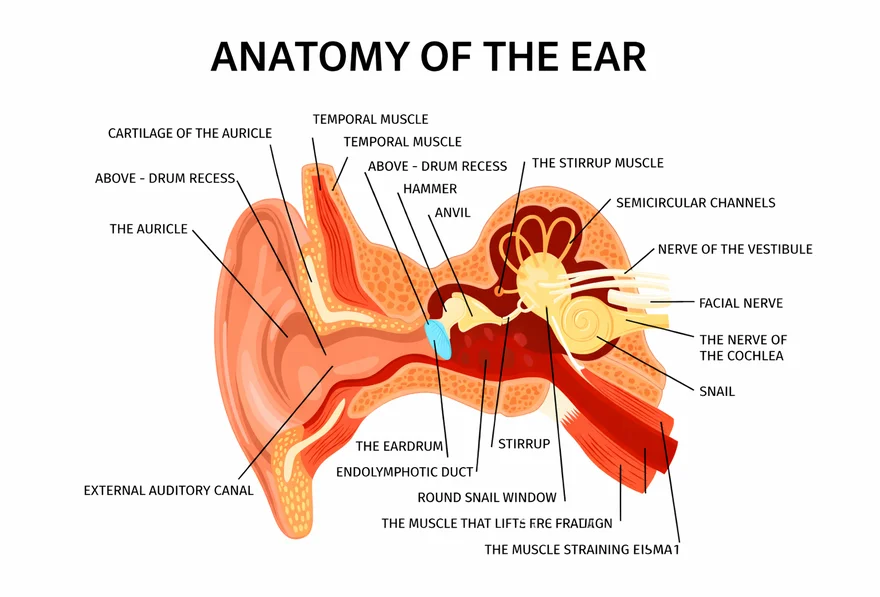
Table of Contents
What is the Inner Ear?
The inner ear is the deepest and most complex part of your ear, located deep within the temporal bone of the skull. It contains fluid-filled chambers and delicate sensory receptors that convert sound vibrations into electrical signals for hearing and detect head movements to maintain balance and spatial orientation. The two main parts of the inner ear—the cochlea (for hearing) and the vestibular system (for balance)—work together to give you clear hearing, spatial awareness, and a steady sense of orientation, even while you sleep.
Anatomy of the Inner Ear
As per a 2015 Journal of Anatomy review (NIH), the human inner ear—occupying just over 150 mm³—consists of a coiled cochlea for hearing and a vestibular complex with three semicircular canals for balance. Its finely tuned structure enables sensitive sound detection and precise control of head and body orientation.
• Cochlea: Spiral-shaped hearing organ where tiny hair cells convert sound vibrations into nerve signals.
• Semicircular canals: Three fluid-filled loops that detect head rotation and help maintain balance.
• Vestibule: Central chamber housing the utricle and saccule, which detect gravity and linear acceleration.
• Membranous labyrinth: Delicate system of sacs and ducts filled with endolymph that houses hearing and balance receptors.
• Vestibulocochlear nerve: Cranial nerve VIII that carries hearing and balance information from the inner ear to the brain.
How Does the Inner Ear Work?
Sound waves travel through the outer and middle ear to reach the inner ear, where the stapes bone presses on the oval window of the cochlea. This movement creates waves in the fluid inside the cochlea. These waves bend microscopic hair cells within the organ of Corti, generating precise electrical signals. These signals are then transmitted via the auditory nerve to the brain, where they are interpreted as sound.
For balance, head movements cause fluid shifts within the semicircular canals and vestibule. Hair cells in these structures. These waves bend microscopic hair cells within the organ of Corti, generating precise electrical signals. The vestibular nerve then sends signals to the brain, which integrates this information with vision and muscle feedback to help you stay upright and coordinated.
Functions of the Inner Ear
Your inner ear performs several critical functions that you rely on every day:
• Sound processing: Converts mechanical sound waves into electrical signals your brain can interpret as music, speech, and environmental sounds
• Balance maintenance: Detects head rotation, linear movement, and gravitational forces to help you stay upright and coordinated
• Spatial orientation: Provides your brain with constant updates about your body's position relative to your surroundings
• Motion detection: Senses acceleration, deceleration, and changes in direction during movement
Common Problems of the Inner Ear
Several conditions can affect your inner ear and cause symptoms like dizziness, hearing changes, or imbalance:
- Hearing loss: Damage to the cochlea or the auditory nerve can cause mild to profound hearing difficulty.
- Ménière’s disease: Recurrent episodes of vertigo accompanied by hearing loss, tinnitus, and a sensation of fullness in the affected ear.
- Labyrinthitis: Inflammation of the inner ear that causes dizziness, imbalance, and sometimes hearing loss.
- Vestibular neuritis: Swelling of the vestibular nerve causes severe vertigo and balance problems without hearing loss.
- Tinnitus: Ongoing ringing, buzzing, or other phantom sounds in one or both ears.
- Benign paroxysmal positional vertigo (BPPV): Brief episodes of spinning dizziness triggered by specific head positions.
Hearing Loss and the Inner Ear
Most permanent hearing loss is sensorineural, meaning it arises from damage to the inner ear or the auditory nerve.
Common causes include:
- Long-term exposure to loud noise
- Age-related degeneration of cochlear hair cells
- Inner ear infection or inflammation
- Certain medications that are toxic to the inner ear (ototoxic drugs)
- Genetic factors and congenital conditions can also cause inner ear disorders. Your doctor can recommend appropriate treatment options.
Balance Disorders Related to the Inner Ear
Balance problems can arise when the inner ear function is disturbed. Typical symptoms of inner ear problems affecting balance include:
- Dizziness or sensation that the room is spinning (vertigo)
- Unsteadiness while walking
- Nausea and vomiting during vertigo episodes
- Blurred vision when moving the head
- Feeling of pressure or fullness in the ear
Diagnostic and Imaging Methods for Inner Ear Disorders
Healthcare professionals use various tests to evaluate inner ear function and diagnose problems:
- Audiometry: Comprehensive hearing tests that measure your ability to hear different frequencies and volumes
- Electronystagmography (ENG) and Videonystagmography (VNG): These tests assess balance function by monitoring eye movements in response to various stimuli
- Vestibular evoked myogenic potentials (VEMP): Measures how well your balance organs respond to sound or vibration
- Magnetic resonance imaging (MRI): Provides detailed images of inner ear structures and surrounding nerves to identify tumours or structural abnormalities
- Computed tomography (CT) scans: Provide detailed images of the bony structures of the ear, helping detect fractures, malformations, or other abnormalities
- Otoscopy: Visual examination of the ear canal and eardrum to rule out external causes of symptoms
- Supporting blood tests (as advised): Tests such as complete blood count, blood sugar, lipid profile, thyroid function, vitamin B12, autoimmune markers, or infection markers may be ordered to detect systemic conditions contributing to inner ear disease.
Treatment for Inner Ear Problems
Treatment approaches for inner ear disease vary depending on the underlying cause and severity:
- Medications: Corticosteroids for inflammation, antivertigo medications (such as meclizine or dimenhydrinate) for dizziness, and antibiotics for bacterial infections
- Vestibular rehabilitation therapy: Specialised exercises designed to improve balance and reduce dizziness symptoms
- Hearing aids or cochlear implants: Assistive devices that help manage hearing loss when inner ear damage is permanent
- Canalith repositioning procedures: Manual techniques to treat BPPV by moving displaced crystals back to their proper position
- Lifestyle modifications: Low-salt diets for Ménière’s disease, stress management, and avoiding known triggers such as caffeine or alcohol
- Surgical interventions: Considered only for severe cases unresponsive to medical or rehabilitative therapies
- Sound therapy: Various approaches to manage tinnitus and improve hearing comfort
Prevention of Inner Ear Issues
While not all inner ear problems are preventable, you can reduce your risk by:
- Protecting your ears from loud noises with earplugs or earmuffs
- Keeping volume low when using headphones or earphones
- Treating ear infections early, as advised by your doctor
- Managing chronic diseases like diabetes, high blood pressure, and high cholesterol
- Avoiding unnecessary or prolonged use of medications known to be ototoxic (use only as prescribed by your doctor)
- Maintaining good hydration and a balanced diet
- Avoiding smoking and limiting alcohol intake
When to See a Doctor
Seek medical care promptly if you have sudden hearing loss, ongoing dizziness or severe vertigo, ear pain, constant tinnitus, or trouble maintaining balance, as these symptoms may signal inner ear problems that need urgent attention. Early evaluation helps prevent permanent damage and allows your doctor to identify the cause and start appropriate treatment.
Conclusion
Understanding your inner ear anatomy and function helps you recognise symptoms like tinnitus, dizziness, or hearing changes early and seek timely care. Because the inner ear controls both hearing and balance, disorders here can significantly affect daily life, but appropriate diagnosis and treatment often provide relief and prevent complications. At Metropolis Healthcare, our comprehensive portfolio of 4,000+ tests includes specialised assessments for hearing and balance disorders, supported by an extensive network of 220+ laboratories and 10,000+ touchpoints across India to bring reliable diagnostics closer to your home. By staying informed, acting early, and consulting healthcare professionals when symptoms arise, you can take charge of your inner ear health and protect your hearing and balance for years to come.
FAQ
What causes inner ear problems?
Inner ear problems can result from various factors, including viral or bacterial infections, autoimmune disorders, head trauma, prolonged noise exposure, certain medications, ageing, and genetic conditions. Some conditions, like Ménière's disease, have unknown causes, whilst others, like BPPV, may develop when tiny crystals in your balance organs become displaced.
Can the inner ear heal itself?
The inner ear has limited self-healing ability because the delicate hair cells in the cochlea and balance organs cannot regenerate once damaged. However, some conditions, like viral labyrinthitis, may improve as inflammation subsides, and your brain can sometimes compensate for balance problems through adaptation. This is why early treatment is crucial for preserving inner ear function.
How do doctors test inner ear function?
Doctors use several methods to evaluate inner ear function:
• Hearing tests (audiometry) to assess auditory function
• Balance assessments using specialised equipment to measure vestibular responses
• Imaging studies like MRI or CT scans to visualise inner ear structures
• Physical examinations, including otoscopy and neurological assessments
References:
https://pmc.ncbi.nlm.nih.gov/articles/PMC4718163/
https://www.ncbi.nlm.nih.gov/books/NBK532978/
https://www.nidcd.nih.gov/health/balance-disorders